Afrikaans History and Development — A Brief Background
Afrikaans — the modern version of the language is much more than merely a Dutch derivative as some would suggest. Inextricably linked for the last century with the development and application of apartheid within South Africa, the immense reach and value of this language has often been overlooked within the wider political climate.
Origins and early influences
While the Dutch, who arrived in South Africa in 1652 and established a colony in Cape Town, are largely credited with the birth of the language, the version spoken today is an accumulation of many other influences. The Dutch dialect established after 1652 incorporated terms and phrases handed down from sailors who had been shipwrecked off the Cape coast after it became clear that the horn of Africa presented another viable trade route. The arrival of the French Huguenots in 1688 almost doubled the European population of the Cape, and also naturally had an immense impact on the spoken language of the day. These phrases, of English, French and Portuguese origin, soon found their way into the Dutch dialect.
In addition, the language took on a more oriental flavour with the arrival of slaves in the Cape, primarily of Malay extraction, but also from other eastern regions and nearby African islands including Madagascar. This spiced the language considerably, and when the accents, dialects and phrases of the original inhabitants of the land were added to the mix, it became evident that Afrikaans was a completely different language to its Dutch parent.
Contributions from local communities
The Hottentots, the original Khoi inhabitants, as well as the Xhosa and the Zulu people all contributed in their fashion to the language as it is spoken today.
Standardisation and written recognition
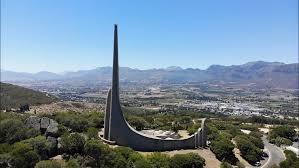
The struggle to gain recognition for Afrikaans as a written language was directed and carried out from the town of Paarl. The Guild of True Afrikaners (Genootskap van Regte Afrikaners) had its inaugural meeting here in 1875 with the aim to establish the new language of Afrikaans in a written form. The Afrikaans Language Monument was erected in 1975 in Paarl to honour the Afrikaans language.
Main dialects
From this development, three main dialects emerged:
- Cape Afrikaans — heavily influenced by the language spoken by the Malay slaves at the Cape, who used a form of broken Portuguese.
- Orange River Afrikaans — developed with the influence of Khoi languages and dialects from Namakwaland and Griqualand West.
- Eastern Border Afrikaans — evolved from settlers who moved east towards Natal from the Cape.
Language and politics
As the language evolved, the white Afrikaans speakers distanced themselves from the predominantly English-speaking community. Believing themselves to be the true white owners of the land and rejecting any claims of the indigenous people, the Afrikaners pitted themselves against the English, culminating in the Anglo-Boer War of 1899–1902.
The Afrikaners lost this war but embarked upon a ‘Kultuur’ campaign (Culture campaign) to promote the language. When the Afrikaans-oriented National Party won the South African elections of 1948, the party introduced measures designed to leapfrog Afrikaans speakers over others in the country in the employment and business sector.
The National Party’s institution of Apartheid and decision to teach black children in Afrikaans only was an unpopular one and was the main reason for the Soweto uprising of 1976. Unfortunately, the National Party’s ruthless Apartheid regime and simultaneous promotion of the language forged a link between the language and the political system that remains to this day.
Post-1994 status
Despite attempts to keep the language as one of only two official languages after 1994, the Constitutional Assembly in the newly democratised South African republic chose to downgrade Afrikaans to only one of eleven official languages, its protected status a thing of the past.